

Notice is given of a Upper Waitaki Zone Water
Management Committee Meeting to be held on:
|
Date:
|
Friday, 19
June 2020
|
|
Time:
|
9.30am
|
|
Location:
|
Twizel Events
Centre Lounge
Twizel
|
AGENDA
Upper Waitaki Zone Water Management Committee Meeting
19 June 2020
Upper Waitaki Zone Water Management Committee
Membership:
Simon Cameron (Chair)
Lisa Anderson
Matthew Bayliss
Richard Subtil
John Sunckell
John Wilkie
Joy Paterson
Kieran Whyte
Ross McRobie
Stuart Barwood
Michael McMillan
***************************************************
The purpose of local government:
(1) The purpose of local
government is—
(a)
to enable democratic local
decision-making and action by, and on behalf of, communities; and
(b)
to meet the current and future
needs of communities for good-quality local infrastructure, local public
services, and performance of regulatory functions in a way that is most cost-effective
for households and businesses.
(2) In this Act,
good-quality, in relation to local infrastructure, local public services, and
performance of regulatory functions, means infrastructure, services, and
performance that are—
(a)
efficient; and
(b)
effective; and
(c)
appropriate to present and
anticipated future circumstances.
(Local Government Act 2002)
|
Upper Waitaki Zone Committee Meeting
Friday 19 June 2020 9.30am
Twizel Events Centre Lounge
|
|
9.00am
|
Item
|
Arrive
|
Lead
|
|
9.30am
|
|
Standing Items
Apologies, Minutes, Correspondence, Conflicts of Interest,
Action List, Matters arising
|
|
|
9.45am
|
1
|
Encouraging responsible toilet use
at Ruataniwha
|
Kate Doran, Environment Canterbury
|
|
10.00am
|
2
|
Ahuriri catchment - Update
|
Tami Woods, Environment Canterbury, Lisa Anderson &
Richard Subtil
|
|
11-11.15am
|
|
Morning tea
|
|
|
11.15am
|
3
|
Mackenzie Basin Agency Alignment Programme - Update
|
Nadeine Dommisse, Environment Canterbury
Hamish Barrell, Waitaki District Council
Ann Rodgers, Mackenzie District Council
Dave Wilkins and Barry Hanson, Department
of Conservation
|
|
11.45am
|
4
|
Zone Facilitator’s Report
|
Tami Woods, Environment Canterbury
|
|
12.00pm
|
5
|
General Discussion
|
All
|
|
12.30pm
|
|
Close
|
|
5 Reports
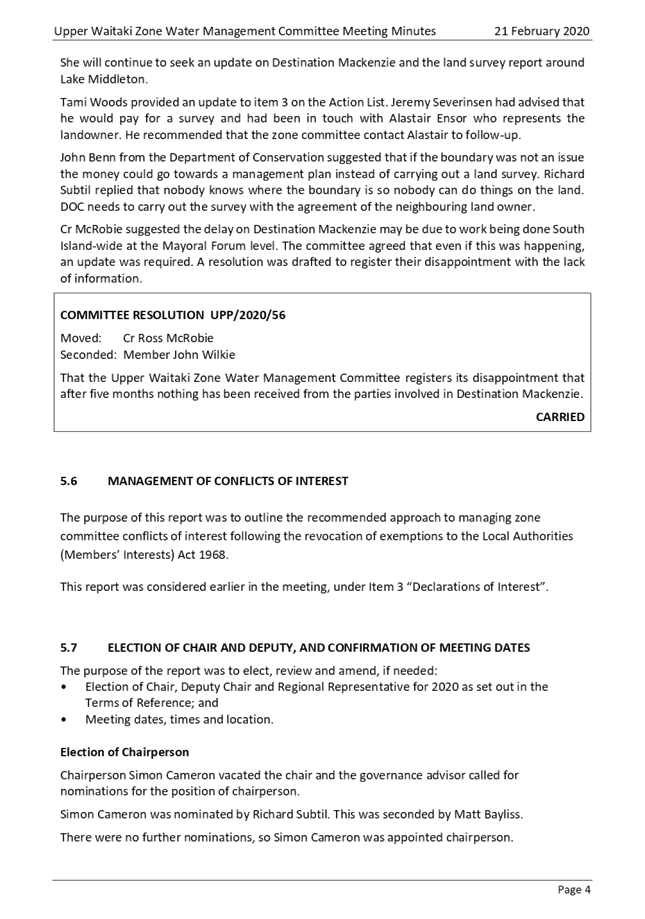
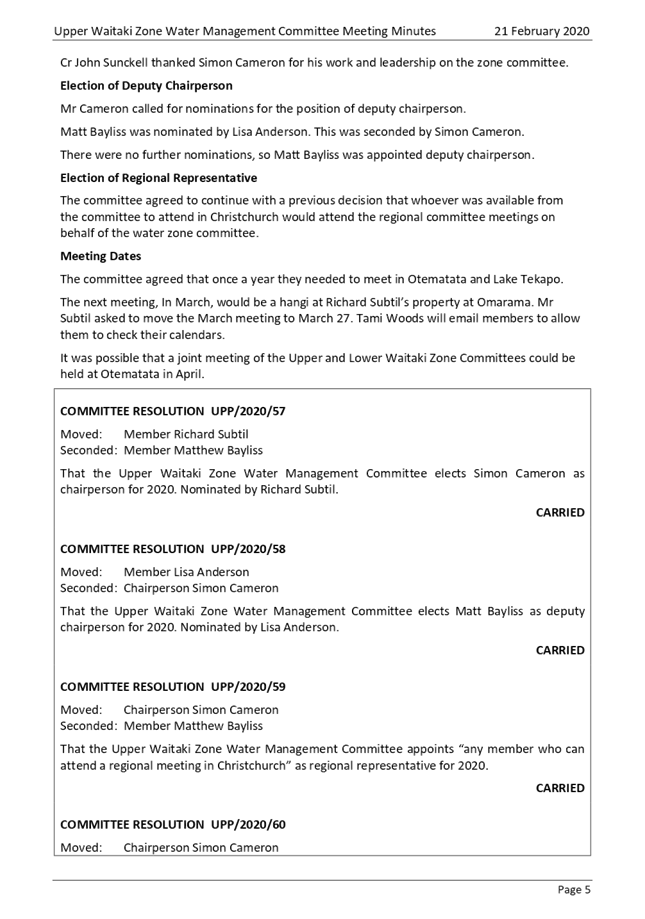
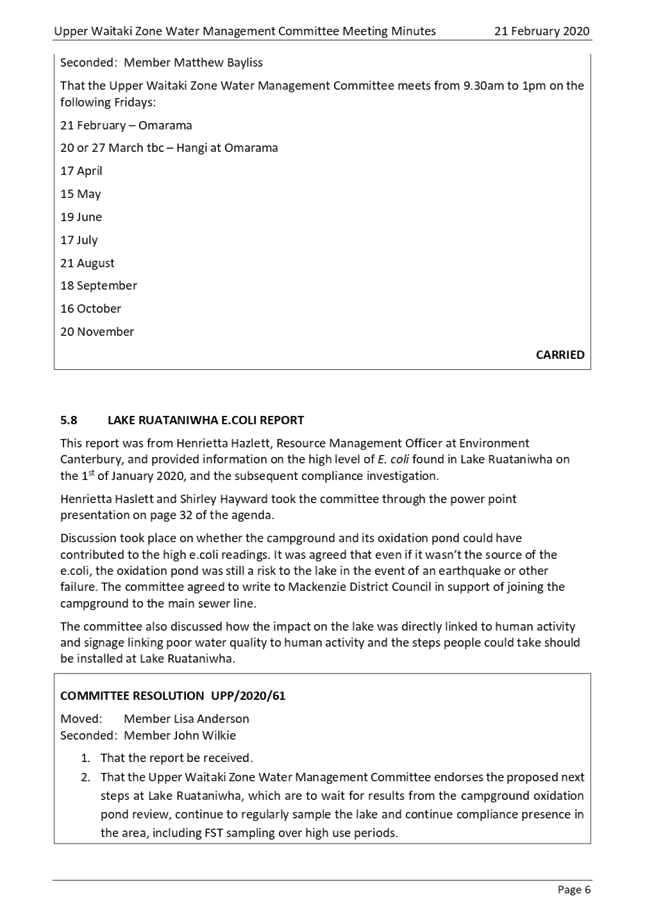
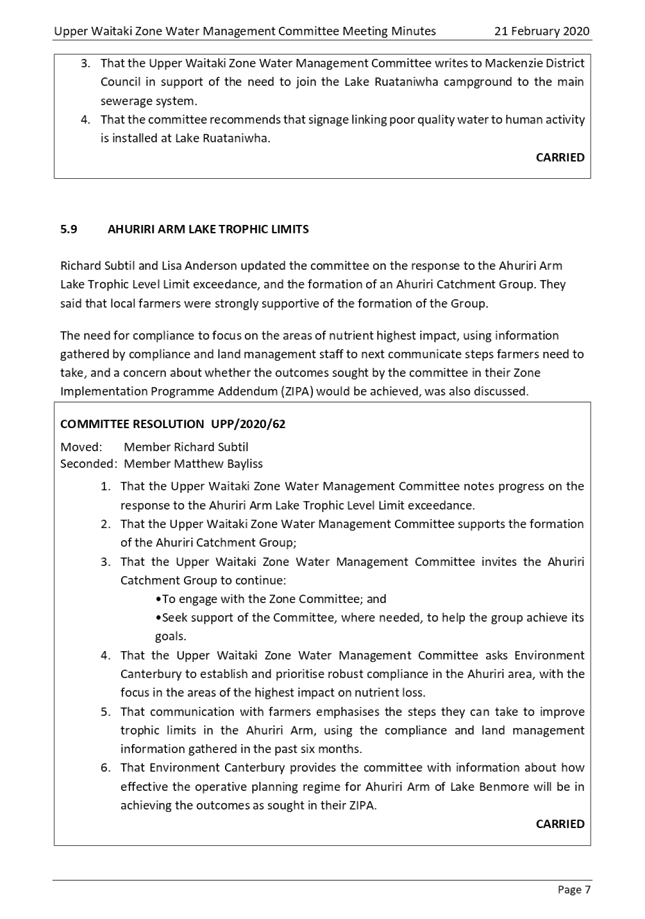
5.1 Minutes
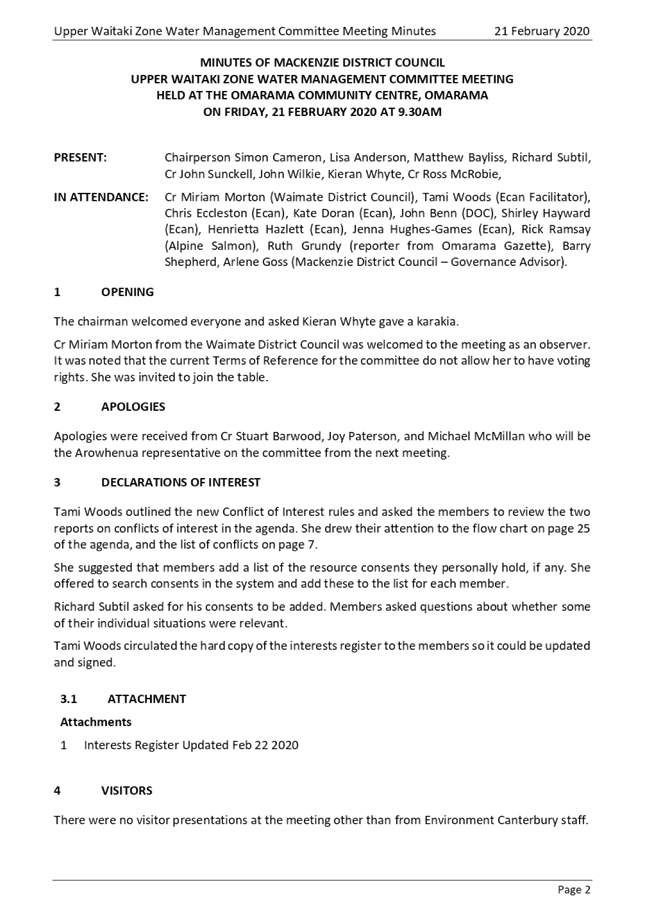
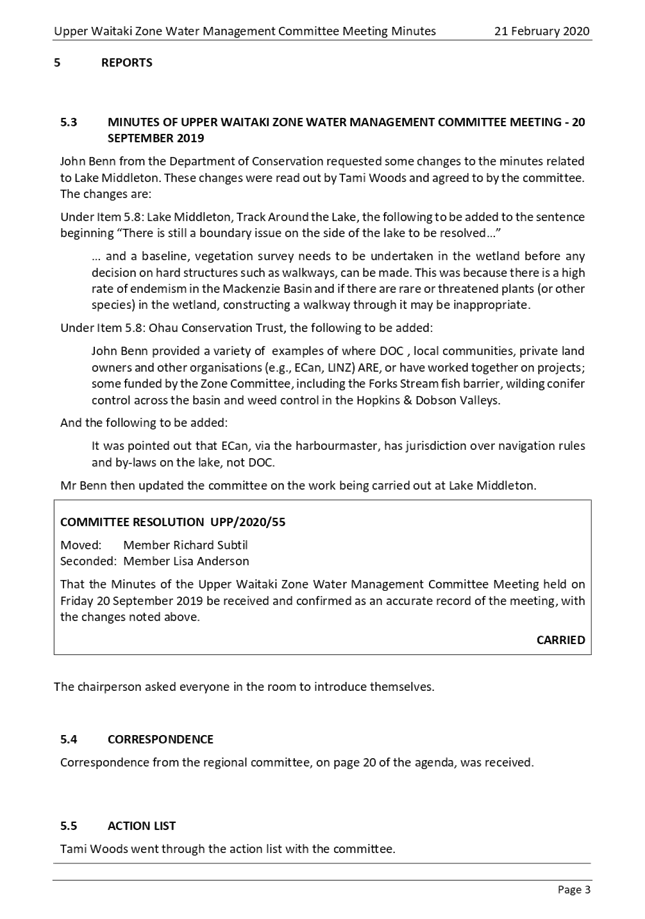
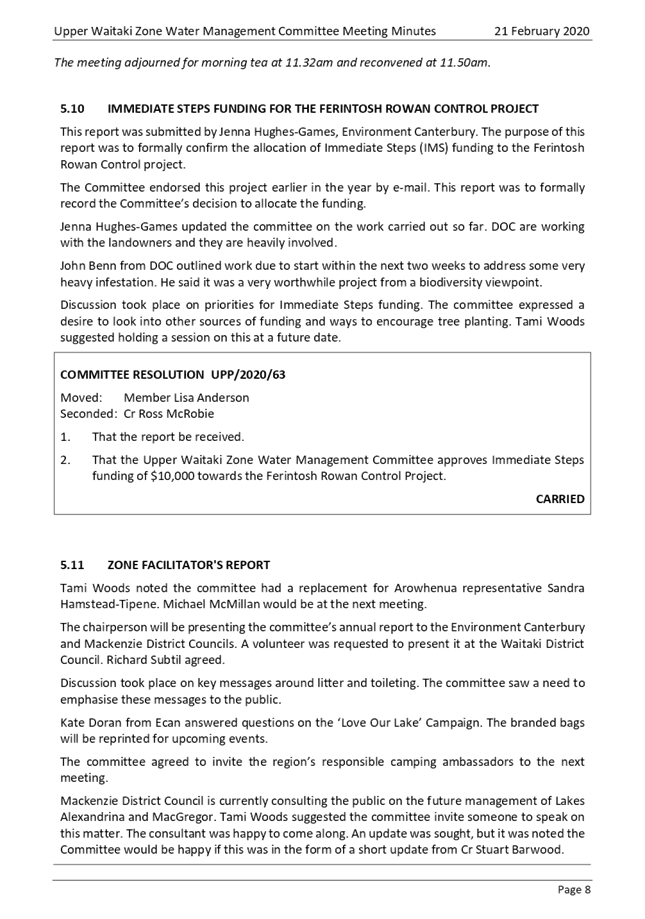
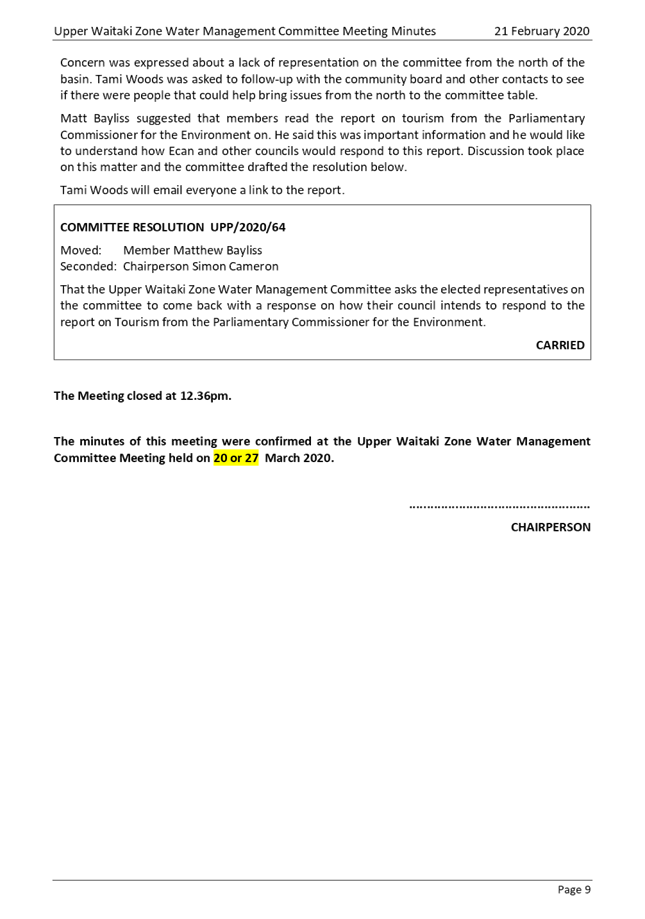
of Upper Waitaki Zone Water Management Committee Meeting - 21 February 2020
File Reference:
Author: Arlene Goss, Governance Advisor
Authoriser:
Attachments: 1. Minutes of the last meeting
of the Upper Waitaki Zone Water Management Committee. ⇩

|
Recommendation
That the Minutes of the Upper Waitaki Zone Water Management Committee Meeting held on Friday 21 February 2020 be received and confirmed as an accurate record of the meeting.
|
Upper Waitaki Zone Water Management Committee Meeting Agenda 19
June 2020
5.2 Interests
Register
File Reference: n/a
Author: Tami Woods, Zone Facilitator
Authoriser:
Attachments: Nil
|
Staff Recommendations
That the information be noted and updated
when required.
|
Declaration of Interests Register
– as at 10 June 2020
Keeping a Zone Committee Members’
declarations of interest register allows Zone Committees to identify and manage
a conflict of interest when it arises.
The
Office of the Auditor General notes a conflict of interest can arise when:
“A member’s or official’s duties or responsibilities to a
public entity could be affected by some other interest or duty that the member
or official may have.”[1]
If a member is in any doubt as to whether
or not they have a conflict of interest, then the Member should seek guidance
from Catherine Schache (General Counsel, Environment Canterbury), the Zone
Facilitator and/or refer to the following guidance: https://www.oag.govt.nz/2010/lamia
Types of Interest to be documented in the
register:
· Employment, trade or profession carried on by the Member or the
Member’s spouse for profit or gain
· Company, trust, partnership etc for which the Member or their spouse is a
director, partner or trustee, or a shareholder of more than 10% shares
· Address of any land in which the Member has a beneficial interest and
which is in the area of the Zone Committee
· The address of any land where the landlord is Environment Canterbury or
[Name of TLA/s] and:
o The
Member or their spouse is a tenant;
Or
the land is tenanted by a firm in which the Member or spouse is a
partner, a company of which the Member or spouse is a director, or a Trust of
which the Member or spouse is a Trustee.
· Any other matters which the public might reasonably regard as likely to
influence the Member’s actions during the course of their duties as a
Member.
· Any contracts held between the Member or the Member’s spouse and
Environment Canterbury or [name of TLA/s]. Including contracts in which the
Member or their spouse is a partner, a company of which the spouse is a
director and/or holds more than 10% in shares, or a Trust of which the Member
or their spouse is a trustee (noting that no committee member should be a party
to a contract with Environment Canterbury or the relevant TLA if that value is
more than $25,000 per annum)
Zone
Committee members are to ensure that the information contained in this register
is accurate and complete.
|
Name
|
Committee Member Interests
|
|
Lisa Anderson
|
Farmer and irrigator in Lake Benmore
Ahuriri Arm catchment. Resource consents CRC201984, CRC136698, CRC156110,
CRC012017.
|
|
Stuart Barwood
|
Mackenzie District Council Councillor,
Chairman Assets and Services committee MDC, trustee of Helwood Trust.
|
|
Mat Bayliss
|
Chairs the Meridian Energy Waitaki
Community Fund. Asset Maintenance Manager for Meridian Energy in Twizel.
Shareholder of Meridian Energy. Consents held CRC142283
|
|
Simon Cameron
|
Local Merino sheep farmer. Trustee of Ben
Ohau Farming Trust. Trustee Cameron Investment Trust. Trustee of Mackenzie
Wilding Trees Trust. Trustee Aoraki Mount Cook Museum Trust. Resource
consents CRC952244, CRC952245, CRC952267, CRC952268, CRC952269, CRC100234,
|
|
Ross McRobie
|
Shareholding Director of RPM Management
Limited, Chair of Otago Community Trust, Trustee Bayliss Family Trust.
Councillor Ahuriri Ward for Waitaki District Council.
|
|
Joy Paterson
|
Member of Canterbury Aoraki Conservation
Board, Trustee of LineTrust South Canterbury. Husband is a Mackenzie District
Councillor.
|
|
Richard Subtil
|
Farmer and irrigator in Omarama
catchment. Member of Omarama Stream Water Users Group. Committee member of
Omarama Airfield. Resource consents CRC010693.1, CRC010694, CRC010727.2,
CRC110202, CRC122382, CRC174573, CRC194088, CRC194520, CRC203348.
|
|
John Sunckell
|
Environment Canterbury Councillor,
Register of interest held by Environment Canterbury
|
|
Keiran Whyte
|
Te Rūnanga o Moeraki, Employee of
Tuna Trap and Transfer Team.
|
|
John Wilkie
|
Te Rūnanga o Waihao. Representative
on the Waitaki Native Fish Committee.
|
|
Michael McMillan
|
Te Rūnanga o Arowhenua.
|
5.3 Action
List
File Reference: n/a
Author: Tami Woods, Zone Facilitator
Authoriser:
Attachments: Nil
|
Staff Recommendations
That the report be received.
|
Background
This report is from Tami
Woods, Zone Facilitator, Environment Canterbury.
The purpose of this report is
to update the committee on progress on items identified at previous zone
committee meetings in 2019 and 2020.
Upper Waitaki Zone Committee – June 2020
Action list (updated from February 2020)
|
Date of
meeting
|
Action
|
Who
|
Status
|
|
21 February 2019
|
Elected representatives on
the committee to come back with a response on how their council intends to
respond to the report on Tourism from the Parliamentary Commissioner for the
Environment.
|
Zone Committee Council
representatives
|
To be
actioned
|
|
21 February 2019
|
Concern was expressed about
a lack of representation on the committee from the north of the basin. To
follow-up with the community board and other contacts to see if there were
people that could help bring issues from the north to the committee table.
|
Tami Woods
|
To be
actioned
|
|
21 February 2019
|
That the Upper Waitaki Zone
Water Management Committee writes to Mackenzie District Council in support of
the need to join the Lake Ruataniwha campground to the main sewerage system
|
Tami Woods
|
Work in
progress
|
|
21 February 2019
|
Signage linking poor quality
water to human activity is installed at Lake Ruataniwha
|
Tami Woods/Kate Doran
|
Refer item
1
|
|
21 February 2019
|
The Committee agreed that
once a year they needed to meet in Otematata and Lake Tekapo.
|
Tami Woods/Arlene Goss
|
To be
actioned
|
|
21 February
|
Joint meeting
of the Upper and Lower Waitaki Zone Committees to be investigated in
Otematata in April.
|
Tami Woods
|
To be
actioned
|
|
21 February 2019
|
That the Upper Waitaki Zone Water Management Committee registers
its disappointment that after five months nothing has been received from the
parties involved in Destination Mackenzie.
|
Tami Woods
|
Zone
Committee to communicate as part of item 3.
|
|
20 September 2019
|
Staff update the Committee
on progress with Destination Mackenzie within one week.
|
Tami Woods
|
No answer
received
|
|
20 September 2019
|
ECan to follow up the
September Clay Cliffs report with communication around the impact of erosion
on the Clay Cliffs
|
Tami Woods & Kate Doran
|
Completed
|
|
20 September 2019
|
Committee recommends that
DOC commission a survey report around lake Middleton and then return to the
Committee for a discussion around next steps
|
Jeremey Severinsen
|
Jeremy
Severinsen had advised that he would pay for a survey and had been in touch
with Alastair Ensor who represents the landowner. He recommended that the
zone committee contact Alastair to follow-up.
|
|
20 September 2019
|
The Committee recommends
that Jeremy Severinsen draft a formal report on DOC timing and plans around
the Drylands Heritage Area with how it aligns with the Mackenzie Trust and
the MDC District Plan for November.
|
Jeremey Severinsen
|
Zone
Committee to communicate as part of item 3.
|
|
16 August 2019
|
A technical group of Environment
Canterbury staff and consultants to further discuss the options to address
inequity between consent holders with TLI trigger levels of 2.75 and 2.9 and
then further discuss options with consent holders.
|
Zella/Bianca and Irricon
|
Held 19
September
|
|
16 August 2019
|
A catchment group for
Ahuriri Arm to be formed as soon as possible and determine what further
science is needed to establish where the nutrients are coming from. Graeme
Clarke’s report to be discussed with the catchment group.
|
Marty Mortiaux
|
Completed
|
|
16 August 2019
|
Environment Canterbury to
then identify where nutrients are originating from within the catchment area
and report back to the catchment group.
|
Marty Mortiaux
|
Completed
|
|
16 August 2019
|
Make Available
Environment Defence Society presentations on Mackenzie available to the
Committee.
|
Tami Woods
|
E-mailed 10
September
|
|
16 August 2019
|
Explore options of
replacement for Committee member Sandra Hampstead-Tipene, in regard to
Arrowhenua rūnanga
|
Brad Waldon-Gibbons
|
Completed
|
|
16 August 2019
|
Regional
Committee dates be included in Committee calendars and be a standing item on
the agenda confirming who could attend
|
Tami Woods
|
To be
confirmed as part of item 1 to this meeting
|
|
19 July 2019
|
Chair to write to Regional
Committee asking for some Committee meetings to be held in Timaru.
|
Committee Chair
|
Completed
|
|
17 May 2019
|
Clay Cliffs – analyse
(for P) a sample of the sediment being eroded from below Clay Cliffs.
|
Graeme Clarke
|
Item 2 on September 2019 Agenda
|
|
17 May 2019
|
Changes to Ahuriri delta
– find out whether there is new LIDAR or other data that provides new
information on build-up of the delta and sedimentation of the lake. If new
data available, then advise committee and indicate whether this can be
analysed and brought to the committee.
|
Graeme Clarke
|
Work in
progress
|
|
17 May 2019
|
Refresh the
committee’s “Posters” at the five locations across the zone
|
Kate Doran
|
Spring and
Summer Posters prepared
|
|
15 February 2019
|
Kellands Pond/Wairepo Arm
– will a hydraulic study be done on how these two waterbodies connect
be done? Previously agreed that a study was needed.
|
Chris to follow up with ECan
Science
|
Work in
progress
|
|
15 February 2019
|
Develop a visual one-page
summary to report progress against the Zone Delivery Work Programme
|
Chris
Eccleston
|
Work in
progress
|
5.4 Encouraging
Responsible Toilet Use at Ruataniwha
Author: Kate Doran, Senior Communications and Engagement Advisor
Authoriser:
Attachments: Nil
|
Staff Recommendations
That the committee recommend the development of a
communications campaign to raise awareness of responsible toilet use at Lake
Ruataniwha to be developed and created in collaboration with key stakeholders
ahead of summer 2020/21.
|
PURPOSE OF
REPORT
This report is from Kate
Doran, Senior Communications &
Engagement Advisor, Environment Canterbury.
This report outlines the
outcomes from the on-line workshop on 15 May with the Committee and next steps.
Workshop and next steps for communications for
Summer 20/21
On Friday 15 May, members of
the Zone Committee took part in a short online workshop to consider and discuss
the proposed next steps for raising public awareness of responsible toilet use
at Lake Ruataniwha in summer 2020/21.
This workshop followed up on a
request from the Zone Committee in February for signage to be created after
high levels of faecal bacteria resulted in the Lake Ruataniwha campsite beach
area being shut down for more than a week during the January 2020 peak holiday
period. The committee asked for the signage to highlight that holiday makers
should be aware of their responsibility to protect (and not degrade) the
quality of the water they are using for recreation.
Environment Canterbury
communications, who support the committee, suggested widening the scope of the
committee’s request for signage to include other channels of
communication and utilise the existing Love Our Lakes branding.
Discussion:
The committee agreed on the
approach to utilise the existing Love Our Lakes brand and collaborate with
other key groups to raise awareness on responsible toilet use at and near Lake
Ruataniwha this summer.
Targeted communication methods
should be used to address key barriers to using toilets (eg. not knowing
location of toilets/not understanding implications of E. coli entering swimming
area).
Next steps agreed:
|
Mid July
|
Site visit and meeting with key stakeholders to plan
campaign overview (invite to include local rūnanga, Mackenzie
District Council, Department of Conservation, Youth rōpū, Lake
Ruataniwha Camping Ground, Mackenzie Tourism, Alps to Ocean Cycle Trail,
Ruataniwha Rowing Club, Zone Committee
Members.
|
|
August
|
Continue to develop campaign. Create collateral
(including regular community posters and Love Our Lakes material for summer)
and organise dates for any events.
|
|
September
|
Present campaign to stakeholders and zone committee.
|
|
October 2020 – April 2021
|
RUN CAMPAIGN
|
|
Peak summer
|
Measurement –survey of visitors on awareness of
toilet locations.
|
|
Autumn
|
Review and debrief
|
Members of the Committee
who volunteered to assist with next steps:
|
Input into collateral
|
Mid July site visit and meeting
|
|
Mat Bayliss
|
Mat Bayliss
|
|
Joy Paterson
|
Joy Paterson
|
|
Richard Subtil
|
Keiran Whyte
|
|
Keiran Whyte
|
|
5.5 Ahuriri
Catchment Update
Author: Tami Woods, Richard Subtil and Lisa Anderson
Authoriser:
Attachments: Nil
Purpose of Report
This report is from Tami Woods, Richard Subtil and
Lisa Anderson.
This report provides:
1. Information on the Lake
Trophic Level Limit (TLI) result for 2019/20 and implications for consent
holders.
2. An update on actions that
occurred in 2019 and early 2020 and the on-going risks that remain about the
TLI in the Ahuriri Arm of Lake Benmore being exceeded in future years.
|
Staff Recommendations
That the
Committee
1. Notes:
a. The 2019/2020 Lake Benmore Ahuriri Arm TLI is 2.75.
b. That a TLI at 2.75 or under does not trigger any additional
actions on top of a farmer’s usual consent requirements.
c. The actions that occurred in 2019 and early 2020 in response to
last year’s TLI of 2.9.
2. Considers how it would like to address
the on-going issues.
|
Context
Lake Benmore is highly valued by all. Environment
Canterbury measures the lakes state using a Trophic Lake Index (TLI).
TLI is not used as an indicator of safety for
swimming; Land and Water Aotearoa reports that the sites monitored in Lake
Benmore are generally suitable for swimming, based on three years of
summer-time monitoring.
The TLI, or the Trophic Level Index, is an index used
across the country as a measure of the nutrient status of a particular lake. A
higher TLI results from higher nutrient concentrations and higher algal biomass
(phytoplankton). Lakes with high TLIs generally have greener and more turbid
(cloudy) water columns.
The low TLI limit of 2.9 for the Ahuriri Arm of Lake
Benmore recognises the lakes good water quality.
The TLI limit for Ahuriri Arm of Lake Benmore was set
to achieve the community outcomes agreed by the Upper Waitaki Water Zone
Committee, which included maintaining its good water quality and providing for
a diverse ecosystem of plant and animal life, recreational opportunities and
customary use.
If the TLI limit is exceeded there is an increased
risk that water clarity will deteriorate, lake colour will change from blue to
green, and there will be algal blooms.
2019/2020 Lake Benmore Ahuriri Arm
TLI
The TLI for Ahuriri Arm of Lake Benmore for the
2019/20 monitoring season is 2.75. This is below the catchment limit of 2.9.
Sampling was unable to be taken in April 2020, due to
COVID-19 Alert levels. An extension to the timeframe for collecting the last
sample was made by Environment Canterbury. The final sample was collected
in May. The table below shows the TLI results from 5 samples taken from
December to May.
|
|
Chla -average
|
TN- average
|
TP-average
|
TLc
|
TLn
|
TLp
|
TLI
|
GRADE
|
|
2019/2020
season incl. May
|
2.480
|
92.600
|
7.200
|
3.222
|
2.309
|
2.721
|
2.751
|
OLIGO
|
Background
In 2019, The Trophic Level Index (TLI) calculations
for the Upper Waitaki Lakes had reached 2.9 which was the lakes TLI limit in
the Land and Water Regional Plan (LWRP).
Although the lake limit was not exceeded, 1/3rd
of the farms in the catchment with water permits (granted prior to the TLI 2.9
limit being included in the LWRP) with an early warning TLI trigger level of
2.75, were required to reduce their nutrient discharge allowances (NDA’s)
and operate within the new allowances.
A further 1/3rd of consent holders consent
holders, with farming land use consents, had no actions required. If the TLI
had however exceeded 2.9 they would have needed to prepare a remedial action
plan.
The last 1/3rd of farms in the catchment,
that are either dryland or with small areas of irrigation and winter grazing,
were not required to carry out any actions linked to the lakes TLI.
This year’s TLI at 2.75 does not trigger any
additional actions on top of a farmer’s usual consent requirements.
Actions in 2019 and early 2020
As a result of the TLI reaching 2.9 last year, the
following actions occurred in response to the Zone Committee’s
recommendations:
· Environment
Canterbury prepared the ‘Cause Report’ on behalf of consent
holders. Consent holder were charged a small fee for the time preparing.
· Meetings were held
with consent holders and their consultants with the 2.75 TLI trigger levels to
clarity the reductions to the NDA’s required and alternative pathway of
demonstrating they were not contributing to the TLI.
· Consent holders
with the 2.75 TLI trigger levels, all made the reductions to their NDA’s
and choose not to take an alternative pathway.
· A technical group of
Environment Canterbury staff and consultants formed to further discuss options
to address the inequity between consent holders and a discussion was then held
with consent holders.
· All farms that
required farming land use consents were followed up to ensure they applied for
their farming land use consents.
· All farms with
Environment Canterbury consents were visited to ensure they were operating in
accordance with their consent conditions.
· All farms with
irrigation were visited by an Environment Canterbury Land Management advisor to
check their irrigation management.
· To support
collective action, all farms in the catchment (and industry bodies) were
invited in December to a catchment meeting. The meeting was independently
facilitated and addressed what was influencing the TLI, including where
nutrients were coming from, the importance of all farms operating at good
management practice (gmp) and what gmp covered.
At the end of the catchment meeting there was good
support for the formation of a catchment group.
A facilitator/coordinator was identified, and a
committee was established to progress the Ahuriri Catchment Collective (ACC).
The focus of the Collective is on education, upskilling and relationship
building. In February topic ideas were identified for the next six
months. The first field event was held in March. This focused on irrigation
management in conjunction with Environment Canterbury Land Management staff.
Progress has been subsequently delayed due to COVID-19.
On-going issues
There are three key issues that Richard and Lisa will
lead a discussion on, at the meeting, which are considered barriers to
achieving the outcomes sought for Ahuriri Arm of lake Benmore in the Zone
Committee’s Zone Implementation Addendum (ZIPA).
1. Inequities across
farms, including:
· Inequities around TLI limits on consents and
the actions required when limits are exceeded;
· Inequities also exist as a result of consents
not being lodged or lodged, but not granted.
2. Everyone operating at gmp or better to minimise the risk of the TLI
limit being exceeded. Everyone operating at gmp was a key assumption to
ensuring the TLI did not exceed 2.9.
· Gmp implementation is checked for consented farms with Farm
Environment Plan’s (FEP’s) that need to be Audited. However, 1/3rd
of farms are also required to implement management plans, that are not
monitored/audited.
· Farms with the highest concentrations of nitrogen are not required
to go beyond gmp.
3. The effectiveness of the planning regime.
· Concern that the outcomes sought for
the Lake (in the Committee’s ZIPA) may not be achieved as the assumptions
about what would be in place compared with the final planning regime,
intensification occurring, and climate predications now differ.
5.1 Mackenzie
Basin Agency Alignment Programme Update
Author: Annabelle Dunn, Programme Manager
Authoriser:
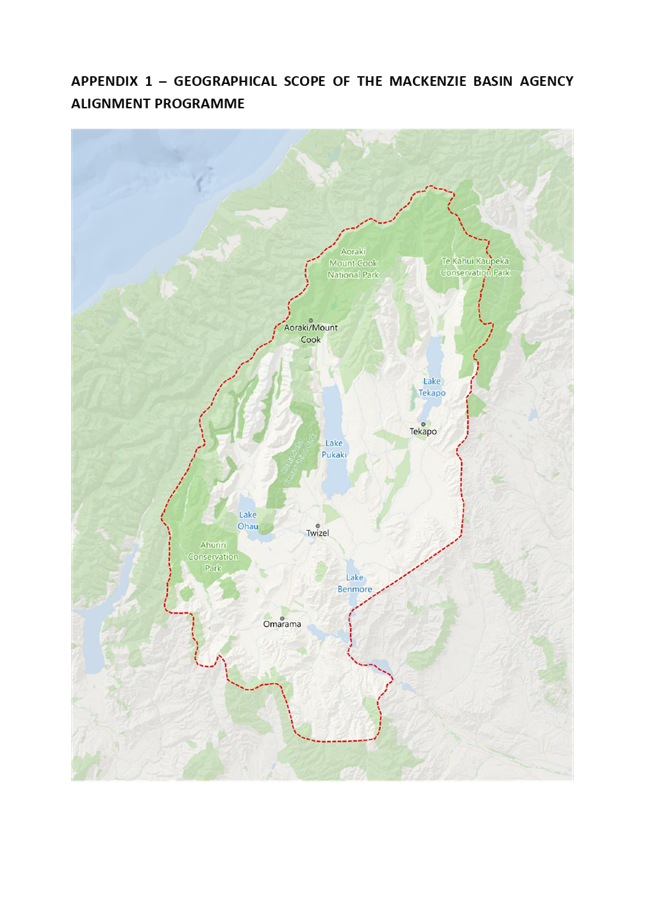
Attachments: 1. Geographical Scope of the
Mackenzie Basin Agency Alignment Programme ⇩

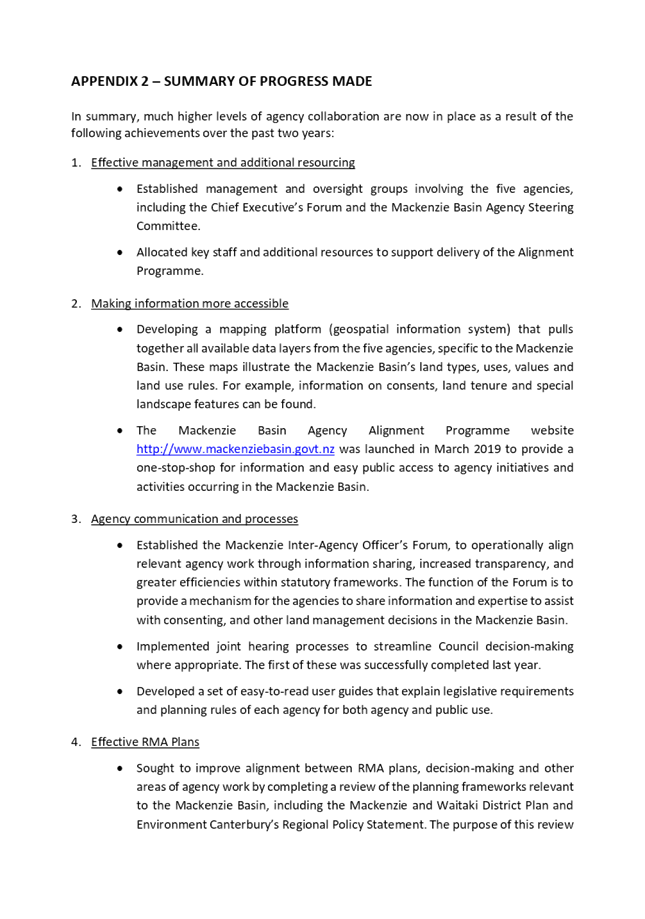
2. Appendix 2: Summary of
Progress Made ⇩

Purpose of Report
This report is from Annabelle Dunn, Programme Manager –
Mackenzie Basin Agency Alignment
The purpose
of the report is to:
1. Follow
up on the last update in August 2019 and provide the Zone Committee (Committee)
with an update on the Mackenzie Basin Alignment Programme (Alignment Programme)
and support discussion between the Alignment Programme Steering Committee and
Committee members.
2. Seek
Feedback from the Committee on the Alignment Programme’s focus areas for
2020 and how the Committee would like to be engaged in these focus areas.
|
Staff Recommendations
That the Committee
notes:
a. the
background information about the Alignment Programme;
b. the
progress made through the Alignment Programme to date; and
c. the
six focus areas for 2020 and current activities.
That the
Committee provides feedback on the focus areas for 2020 (to be discussed at
the meeting).
|
Background
1. During 2017, the five statutory agencies
with environmental responsibilities in the Mackenzie Basin formed a
leading-edge alliance, a first for New Zealand. The Alignment Programme
acknowledges that the agencies have individual and collective responsibility to
partner with mana whenua, work with farmers and communities to protect the
iconic landscape, together with its water quality and biodiversity.
2. The group comprises the Mackenzie District
Council, Waitaki District Council, Environment Canterbury, Land Information New
Zealand, and the Department of Conservation. The five agencies’ functions
include management of land use, landscape, water quality and quantity,
vegetation clearance, biosecurity and biodiversity. The agencies have different
statutory responsibilities which at times overlap (see attachment 1 for the
geographical scope of the Alignment Programme).
3. The Alignment Programme was established in
early 2018. Its formation was one of the key recommendations of the Mackenzie
Basin – Opportunities for Agency Alignment report (the report),
prepared by Dr Hugh Logan and John Hutchings (26 January 2018). The purpose of
the report was to investigate how higher levels of agency alignment could be
achieved, applying best public sector practice to better realise the outcomes
desired by the community.
4. The report suggested 25 recommendations, which
the Mackenzie Basin Agency Steering Committee (MBASC) used to develop a work
programme. The Alignment Programme has made significant progress to date,
including establishment of management structures, delivery of several priority
projects and implementation of supporting work (see appendix 2 for details).[2]
5. The
Alignment Programme is unique in that it is the first time in New Zealand that
a cross-agency programme of this scale has been undertaken that focuses on
improving how agencies work together to achieve the outcomes desired by
the community in one of New Zealand’s most iconic landscapes.
6. The purpose of the Alignment Programme is
to make a transformational shift in the way that agencies join together to
undertake their statutory functions, leading to improved environmental and
social outcomes through the delivery of core work. The goal of the Alignment
Programme is to show that Mackenzie Basin agency alignment leads to better (1)
environmental and community outcomes, (2) effective service delivery and (3) is
seen as an exemplar of collaboration and partnership.
7. During your meeting on 16 August 2019,
Karina Morrow (the Programme Manager at that time) provided an update on the
Alignment Programme. Since you received this update, the focus has continued to
be threefold:
I. establish
better working relationships, understand the work each agency is doing, and
keep each other informed of decisions;
II. deepen
relationships and Treaty Partnership with Papatipu Rūnanga as mana whenua
of the Waitaki; and
III. improve
the Resource Management Act planning and consenting processes across the
councils to be more joined-up.
EVOLVING THE PROGRAMME – FOCUS
AREAS 2020
8. The
MBASC has developed a forward view of the Alignment Programme, identifying the
following six focus areas for 2020. These are outlined below along with an
update on current activities.
I. Grow
agency collaboration – This focus area
is about increasing the value of collaboration between the agencies,
Councils and iwi in delivering projects. Supporting activities will seek to
evolve the Alignment Programme to ensure ownership at the governance level
across all agencies and with the Treaty Partner (Minister for
Conservation and Land Information New Zealand, District Council Mayors,
Environment Canterbury Chair and the Chairs of Papatipu Rūnanga).
II. Enhance
and deliver Treaty Partnership – This focus area is about
continuing to work with Papatipu Rūnanga to explore what Treaty
Partnership means for the Alignment Programme. Supporting activities will seek
to develop a relationship engagement framework consistent with the mana to mana
principle (right resource/person at the right level). A principled agreement
with a supporting work programme may also be developed.
A hui that was
set to take place between Papatipu Rūnanga and the Minister for
Conservation and Land Information New Zealand, the Environment Canterbury Chair
and the Mayors of Mackenzie and Waitaki District Councils on 26 March did not
occur due to Covid-19. The three Mackenzie Rūnanga have recently
advised that they are keen to meet and are proposing August for this
Minister/Governance/Rūnanga hui.
III. Support
economic recovery from COVID-19 with nature based employment –
This focus area is about leveraging the established, trusted partnership group
that the Alignment Programme has built across agencies to support the Mackenzie
Basin’s recovery from COVID-19. Supporting activities will seek to use
the mana and expertise of the Alignment Programme to attract recovery funding
by engaging with the Crown, the private sector and key stakeholders. The
Alignment Programme understands the challenges faced by the region, provides a
solid framework for co-ordinated deployment of resources in the Basin and is
also well equipped to carry out or support critical programmes such as pest
control.
Since the onset of COVID-19, the
Alignment Programme has supported the Department of Conservation’s successful
Revitalising communities through nature-based employment proposal. This
has been funded $200M from the Government’s COVID-19 Recovery Fund and
will enable regional delivery of jobs. The five agencies have also welcomed the
government’s announcement of a further
$2million funding for wilding pine control, both in the Basin and elsewhere in
Canterbury. Three new projects have been announced, to tackle both the problem
of wilding pines and employ about 50 people who have been hardest hit by the
economic fallout of COVID-19.
IV. Align
information, regulatory plans and approaches – This focus area is
about developing consistent agency information and sharing in the development
and implementation of agency policies (e.g. planning instruments, strategies, monitoring
and compliance) to ensure the right outcomes are achieved. Supporting
activities will seek to develop consistent technical information to support
regulators and explore opportunities and new ways of working together.
Current activities include exploring
a joined up approach to compliance and monitoring resourcing; continuing to
bring all agency maps and data into one place and making it easily accessible
to support agency work; investigating the feasibility of cross-warranted
Compliance, Monitoring and Enforcement officers; and reviewing the Waitaki and
Mackenzie District Plans to address gaps and enable better protection of the
region’s indigenous biodiversity and iconic landscape.
V. Support
wider agency initiatives – This focus area is about providing a pathway for strategic conversations, cross-agency coordination and
resolving issues that are common to these wider agency initiatives There
are several wider agency initiatives occurring in the Mackenzie Basin that have
strong links between the outcomes they are seeking to achieve and the goal of
the Alignment Programme. These initiatives are managed separately and are
accountable to individual agencies, but their success cannot be achieved in
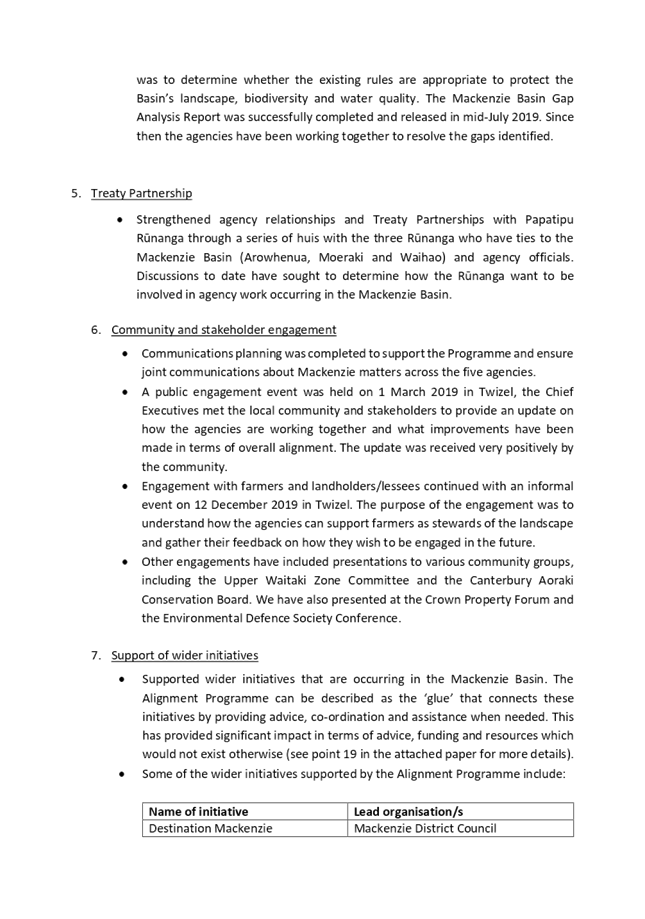
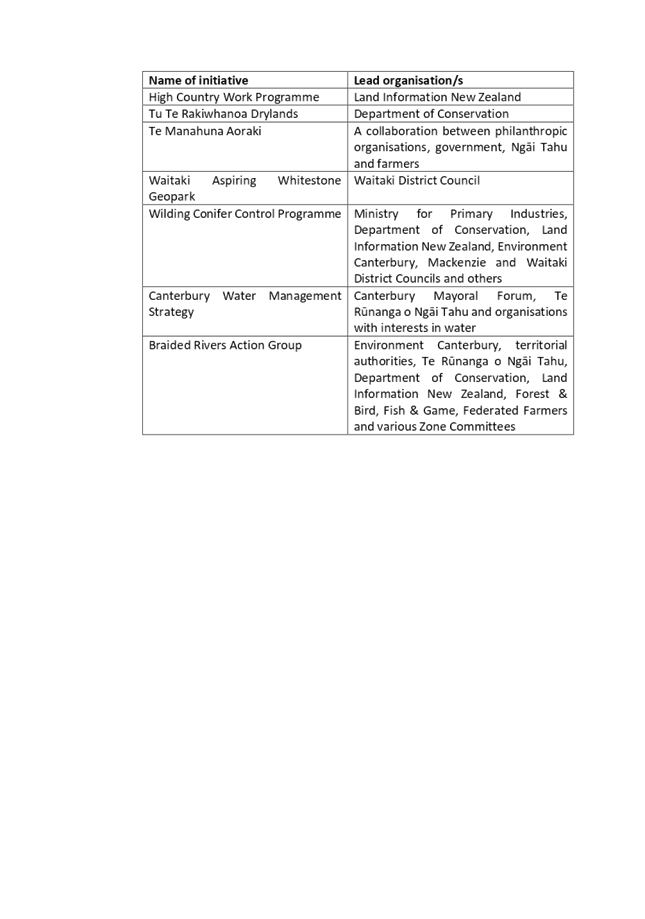
isolation (see appendix 2 for a list of these initiatives).
Activities this year will seek to
continue to support agency projects and develop frameworks for project managers
and key staff to connect within the Mackenzie Basin. Practical and tangible support
that is making a real difference includes:
Ø Central Government support to
Local Government in recognition of the critical role of District Plans –
DOC and LINZ have provided a total of $200,000 ($100,000 to Mackenzie District
Council and $100,000 Waitaki District Council).
Ø Joined up communications across
the five agencies – for example, ensuring communications and press
releases are aligned and do not cut across other agencies' announcements.
Ø DOC and LINZ commissioned the
Environmental Defence Society to report on new ways to protect New Zealand
landscapes with the first case study on the Mackenzie Basin. The report was
released this month, which showed strong community support for the Alignment
Programme.
Ø Supporting Mackenzie District
Council on Destination Mackenzie with in-kind work and agency support for
Provincial Growth Funds awarded. Additional resource support and specialist
expertise including planning, mapping and ecological advice is also being
provided.
Ø Joined up efforts to control
Wilding conifers in the Mackenzie Basin through the Mackenzie Wilding Conifers
Group.
Ø Supporting Te Manahuna Aoraki
– LINZ is assisting with a coordinated approach to biosecurity control
(wilding conifers and rabbits), including data collection and presentation of
pest control information. DOC is a major funding partner for the project and
works closely with Te Manahuna Aoraki Limited (the company delivering the
work), providing seconded staff members, support with governance and expert
advice/guidance for the biodiversity and operational work on the ground.
Ø Working with farmers to support
their work on reducing biosecurity threats and increasing our compliance and
monitoring programmes so that we can take a joined up approach to inspecting
properties. Working with farmers to support their efforts to reduce biosecurity
threats and increase our own compliance monitoring programmes.
VI. Align
and improve agency engagement activities – This focus area is
about helping agencies demonstrate a consistent engagement approach with key
stakeholders in the Mackenzie Basin. Supporting activities will seek to develop mutual commitments for collaboration, engagement
and communication between the five agencies, Mackenzie community organisations and other government agencies.
The Alignment
Programme is currently developing a cross-agency engagement package that will
include a set of engagement principles for all agencies to use, as well as a
suite of supporting tools. Planning for further engagement with farmers is
underway including identifying practical projects that deliver benefits
for farmers; aligning a team of agency staff in the Basin as key contacts for
lessees; and investigating the potential for a ‘trusted advisor’
role. The Programme is also working to engage with community organisations and
other government agencies to develop mutual commitments
for collaboration, engagement and communication regarding Mackenzie matters.
Upper Waitaki Zone Water Management Committee Meeting Agenda 19
June 2020
Upper Waitaki Zone Water Management Committee Meeting Agenda 19
June 2020
5.1 Zone
Facilitator's Report
Author: Tami Woods, Zone Facilitator
Authoriser:
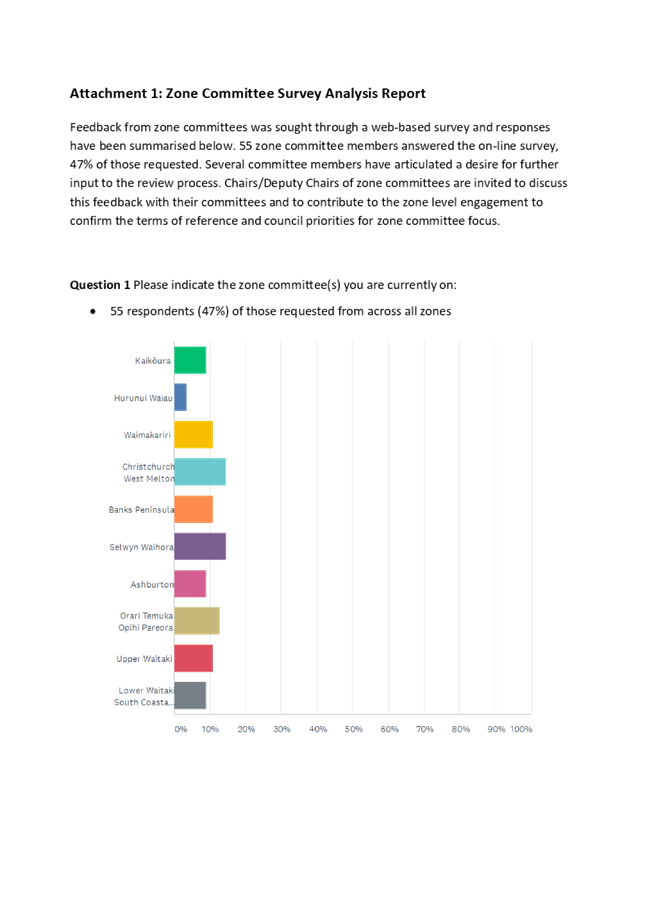
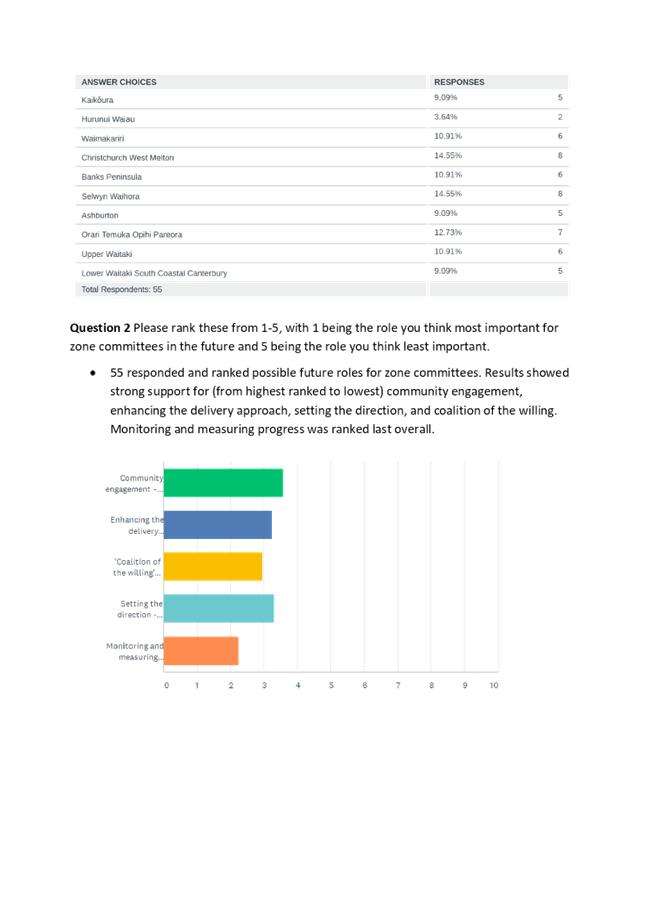
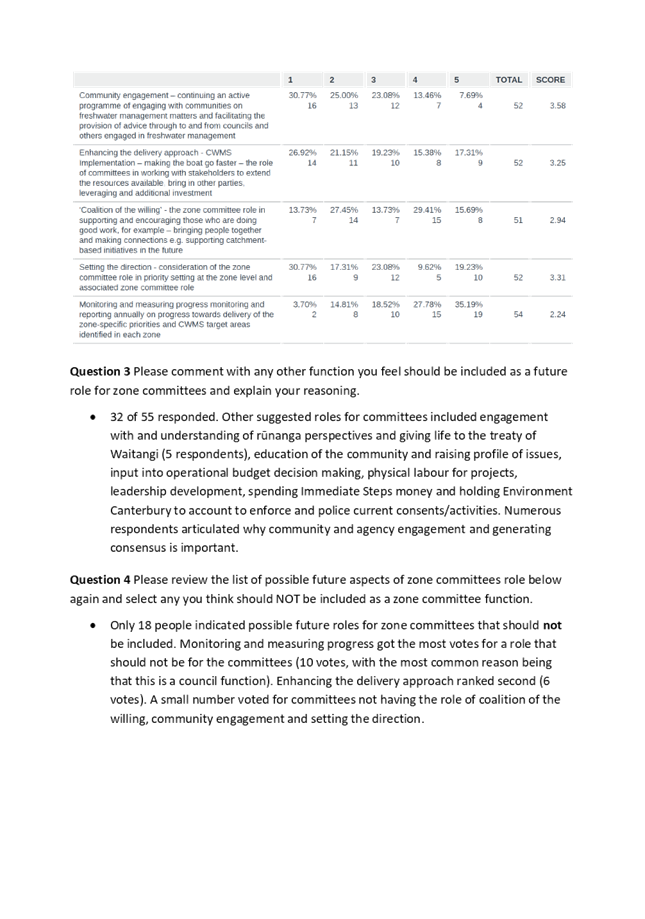
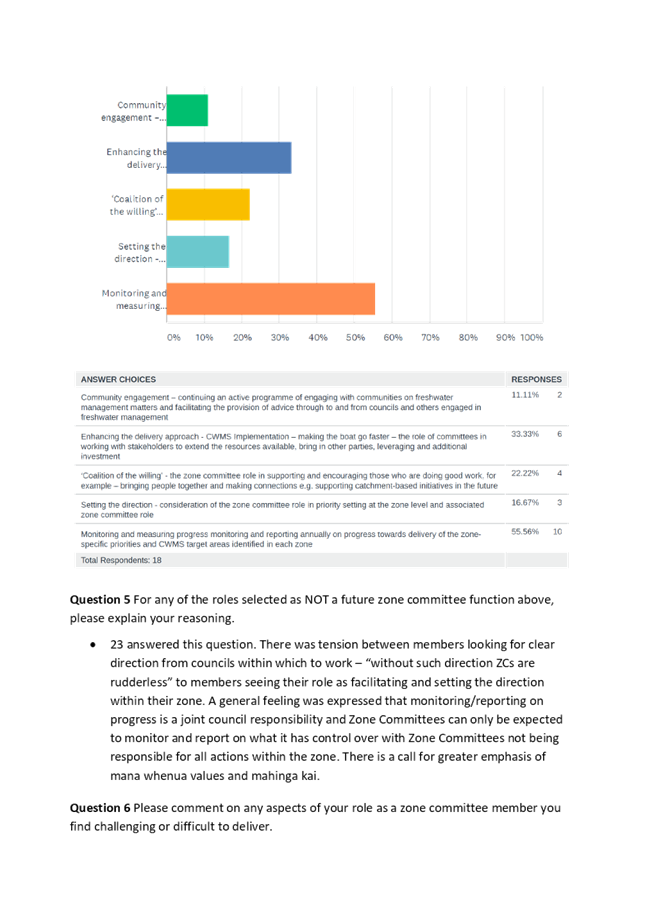
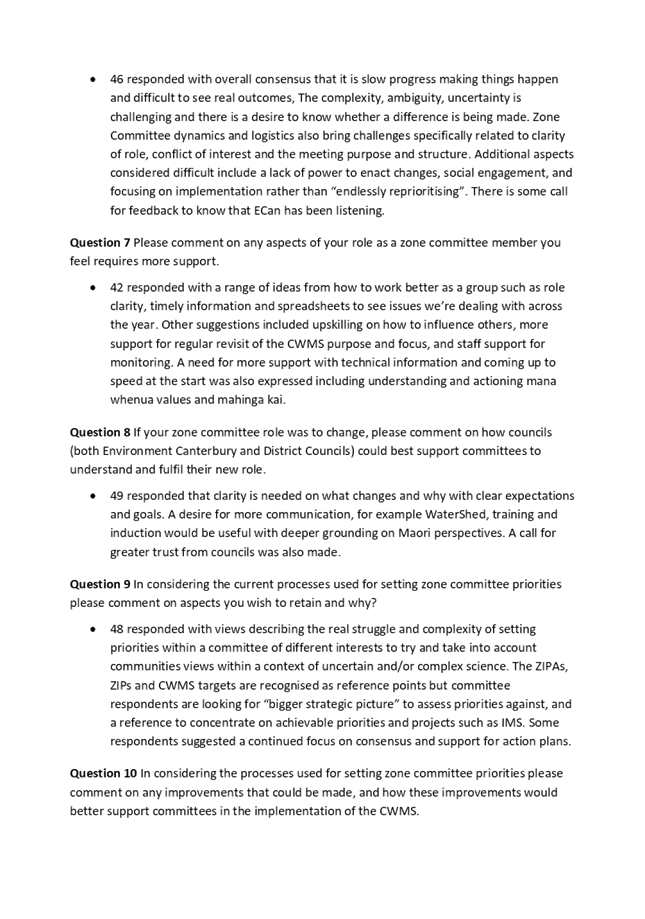
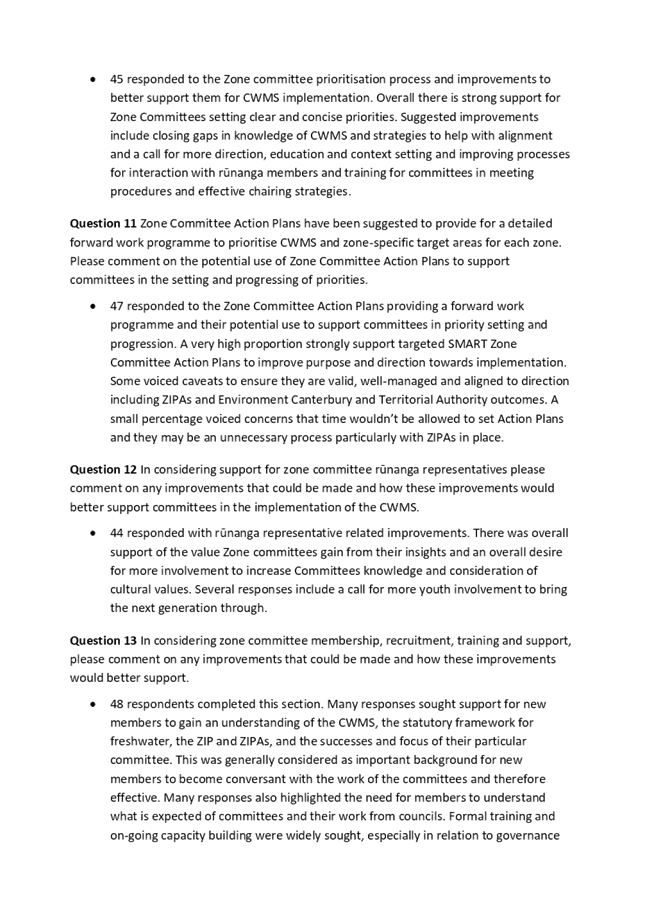
Attachments: 1. Zone Committee Survey Results
- Summary ⇩

2. Freshwater Package
Announcement 28 May 2020 ⇩
3. Groundwater Quality QA ⇩

4. Mackenzie Basin Landscape
Report Key Messages ⇩
5. New Aerial Photography of our
Region ⇩

6. Environment Canterbury
Consents in Process ⇩

Purpose of Report
This report is from Tami
Woods, Zone Facilitator, Environment Canterbury.
This report provides
information that may be of interest to the Zone Committee that is not covered
elsewhere in the agenda or where feedback is sought to inform the focus for the
committee.
|
Staff Recommendations
1. That
the report be received.
|
1. Committee Member Changes
Since last
formal meeting of the Committee, Michael McMillian has joined the committee as
the rūnanga representative replacement for Sandra Hampstead Tipene from
Arrowhenua.
2. Zone Committee Review –
Update
As part of the recent Fit for Future project (that
added 2025 and 2030 targets to the CWMS), the Mayoral Forum have asked
Environment Canterbury to lead some advice on how to help zone committees focus
on implementation of the CWMS.
This advice:
· takes into account the ten years of evolution of the
Canterbury Water Management Strategy (CWMS) and all the work by zone
committees, now completed, to develop implementation programmes (ZIPs
and ZIPAs) tailored to each unique zone and community
· sits alongside several other reviews of differing
types in Hurunui Waiau, Selwyn Waihora and the development of the Regional Work
Programme on behalf of the Mayoral Forum.
The latter outlines what initiatives are recommended to deliver on the 2025
CWMS targets.
Where are things at:
Over the last few months,
Environment Canterbury has been developing a series of suggestions for
improvements and changes to the role and function of zone committees. These
have been discussed with Environment Canterbury’s Councillors, and are
now ready for discussion and further work with Territorial Authorities,
Rūnanga Reps, and Zone Committee representatives.
The draft advice was based on
councillor advice, the reviews, in-person conversations with CWMS rūnanga
reps and two zone committees, and the results of the on-line survey sent to all
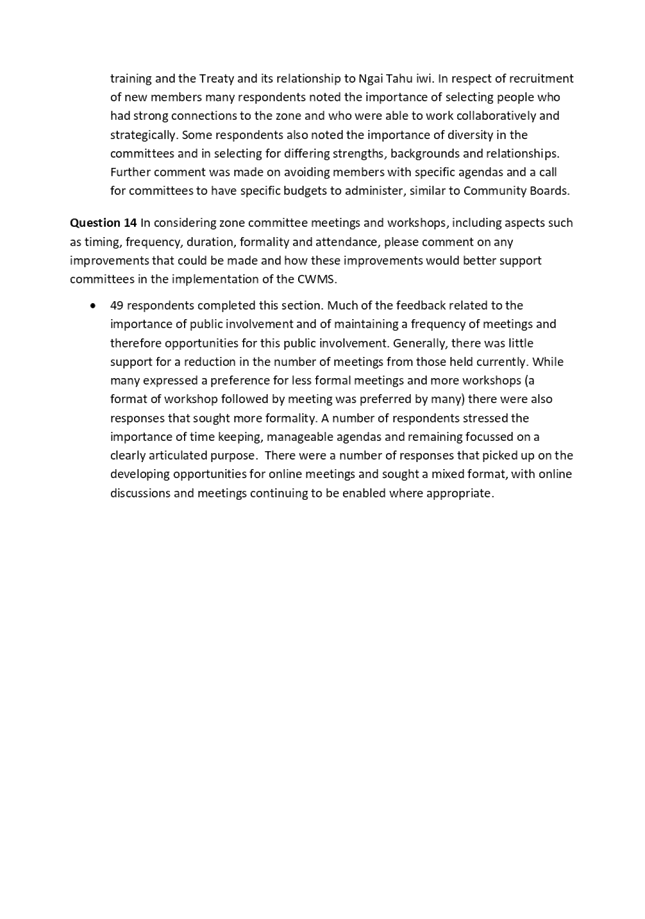
committee members in May. Attachment 1 summarises the zone committee
survey results.
In a nut-shell the draft
advice includes:
· Some
suggested changes to the Terms of Reference (including zone committee role) and
selection process
· A
Letter of Shared Priorities sent to the zone committee every 3 years by the
Territorial Authority and Environment Canterbury. The Letter of Shared
Priorities will outline the Regional and individual Territorial priorities for
each Zone Committee
· A
requirement for Zone Committees to develop their own three-yearly Action Plan
that will be owned, monitored and reported on by the committee.
What’s next
Regional and TA Councillors
will work together with Rūnanga reps, ZC Chair/Deputy, Facilitators and
senior staff from each Council to:
· Discuss,
enhance and agree on the proposed changes including the TOR and proposed action
plans and selection process changes
· establish
priorities for the letter of Shared Priorities for individual zones
This work is anticipated to be
advanced in July, with careful consideration of TA’s and Zone Committees
capacity to focus on this while also addressing the range of contingencies they
are currently facing as a result of Covid-19 and/or the Government’s
Freshwater package.
Once confirmed, Environment
Canterbury and TA Councils will formally endorse the revised TOR and confirm
their Letters of Shared Priorities. The aim to have this in place by the end of
July, subject to the Covid-19 contingencies Councils are facing.
A further update on how this
review is progressing will be provided in July.
3. Regional Committee
The Regional Committee is not meeting in June. In July they
will however have a workshop on the possible future Regional Committee
functions, form and ways of working.
The date for the workshop has not been confirmed, but it
would be good for there to be an Upper Waitaki Zone Committee presence at the
workshop - so a volunteer to attend will be sought.
4. Love
Our Lakes Update
Please refer to item 1
Encouraging responsible toilet use at Ruataniwha for future focus of
‘Love our Lakes’ for this summer.
Please also note that Winter
posters for ‘Love Our Lakes’ have not been developed for this year
due to COVID-19
5. Our Freshwater Report
The Ministry for the
Environment and Stats NZ have released Our Freshwater 2020 in April.
https://ecan.govt.nz/your-region/your-environment/water/canterburys-water/freshwater/
The Report provides a national
overview of the pressures on freshwater, and impacts from these, together with
changes in state (and trends) through the lens of three themes and four
environmental issues. The themes are water quality; water quantity and flows;
freshwater ecosystems, habitats and species. The issues in the report are:
· Our native freshwater
species and ecosystems are under threat
· Water is polluted in
urban, farming, and forestry areas
· Changing water flows
affect our freshwater
· Climate change is
affecting freshwater in Aotearoa New Zealand.
The report provides a national
picture of the pressures, states, and impacts on lakes, rivers, and
groundwater. While recognising that significant regional variations exist, the report
does not provide specific regional information or commentary on how freshwater
is being managed – this is out of scope. The Secretary for the
Environment and Government Statistician, in their introductory comments, state
that changes in the state of our freshwater – both positive and negative
– can take time. Some effects we are seeing today are legacies from
our parents and grandparents. In some places we can expect to wait
decades to see the results of our efforts to raise the health and mana of freshwater.
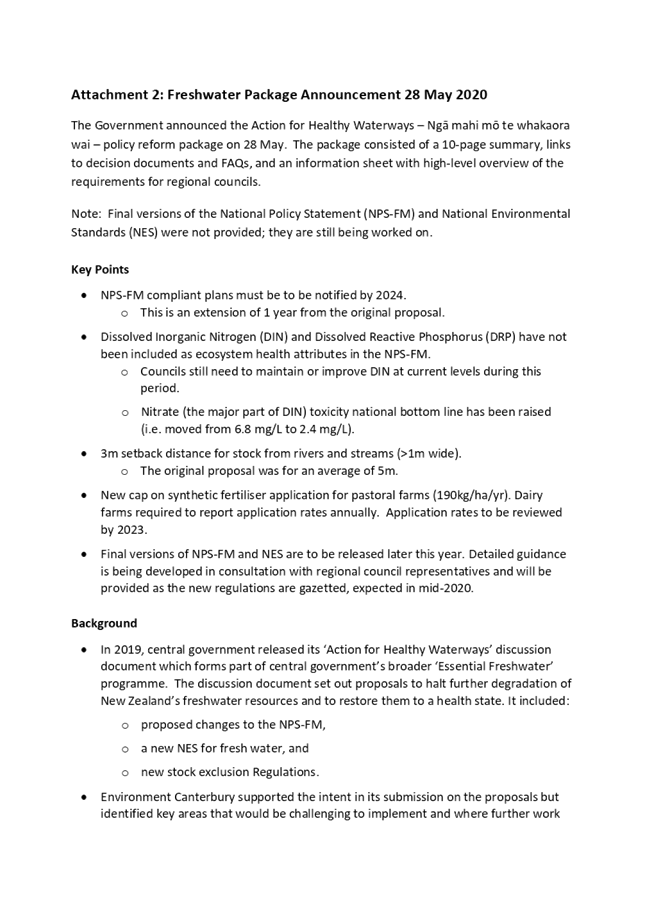
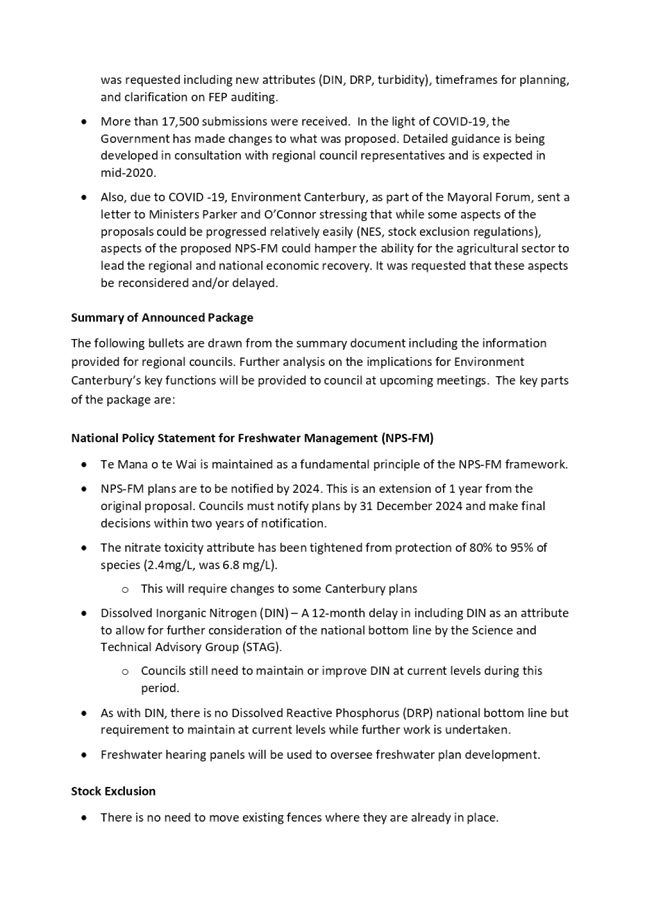
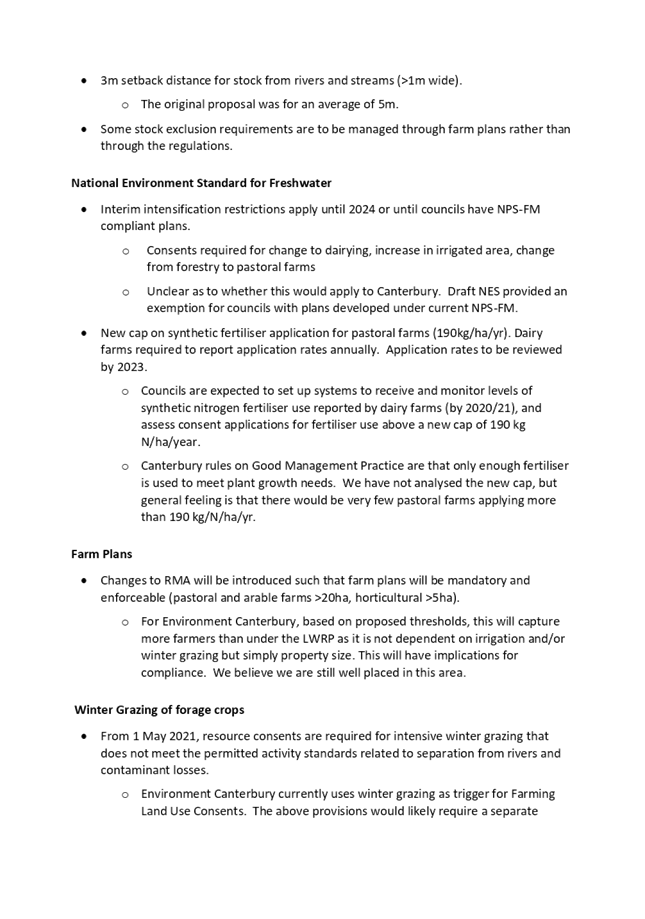
6. Freshwater Package Announcement 28 May
2020 – Action for Healthy Waterways
Attachment 2 provides an overview of the Freshwater Package
Announcement.
Further information can be found at https://www.mfe.govt.nz/action-for-healthy-waterways
Environment Canterbury is waiting on the
content of the National Policy Statement and National Environmental Standards
however to fully understand the implications of the announcements.
7. Groundwater Quality Reports
Two ECan groundwater reports
have been recently published and the new LAWA groundwater quality topic has
been launched:
https://www.lawa.org.nz/explore-data/groundwater-quality/
A link to the LAWA topic and
our reports have been published on these pages:
https://ecan.govt.nz/your-region/your-environment/water/canterburys-water/
https://ecan.govt.nz/your-region/your-environment/water/canterburys-water/groundwater/
Questions and Answers for you
to refer to are included in Attachment 3.
Below are some key messages
from each report from Environment Canterbury:
Groundwater survey
· Our
annual survey reports data to 2019, so is a little ahead of LAWA
· The
focus is on nitrate trends and results, which are particularly important to
Cantabrians and all New Zealanders
· We
welcome all research into the health impacts of nitrate in waterways
· This
survey shows little change from earlier ones in line with our predictions (we
expect little improvement for 15-20 years due to legacy effects, although our
plans and on-the-ground action are having an impact)
· See https://ecan.govt.nz/get-involved/news-and-events/2019/nitrate-in-waterways-whats-the-story/
Nitrate risk maps
· For
those with private wells drawing water from shallow aquifers
· Little
change since 2017
· Used
by Community and Public Health to ensure safe drinking water for private well
owners - see https://www.cph.co.nz/your-health/drinking-water/ for individual zone maps.
LAWA groundwater
quality topic
· We
welcome the launch of the topic – it’s a valuable addition to the
water / environmental information now available to the community that LAWA has
been building for some time, with support from councils
· It
brings ECan data (from last year) into a national framework
· We
also welcome the E.coli trends data (something ECan collects but
we’ve not been reporting).
8. Te Manahuna Mackenzie Basin and
Landscape Protection Report
On
10 June the Environmental Defence Society (EDS) report
released the ‘Te Manahuna – Mackenzie Basin and Landscape
Protection’ Report.
The
report covers the Historical context, pressure on the landscape, current
management responses and further management responses, including:
· Filling gaps
· Strengthening the law, policy and planning framework;
· Integrated agency management; and
· Adopting a new approach
Attachment 4 includes the key messages from the report.
The full report is at https://www.eds.org.nz/our-work/eds-landscape-project
9. Potential opportunity of funding to
support UW catchment or rural community groups
The Ministry for Primary Industries has an
Extension Services Programme that has been set up to partner with farmers,
regional stakeholders, industry groups and agricultural professionals to ensure
services are relevant to the needs and priorities of local communities. Where
possible this work is to build on existing capability and build more connected
network of farmers, rural professionals, industry groups, and government.
In the new context of the Covid-19
pandemic central and local government are also considering COVID-19 recovery
and gathering information about how best to partner with those on the ground to
achieve the best outcomes. The Mackenzie Basin Agency Alignment Programme has
been active in this space.
There is however also an opportunity for
the zone committee to become central to any partnering with catchment and rural
community groups to gather ideas that could be packaged together for funding
where it relates to water management outcomes. Initial funding from the MPI
Extension Services Programme could co-ordinate funds across South Canterbury,
to support the establishment, build capacity within groups and deliver
catchment and rural community group activities.
The key objectives for establishing a
wider connected South Canterbury based approach (linking in with Lower Waitaki
and OTOP Zones) could be to:
• Sell the idea of one central conduit in South
Canterbury.
• Engage catchment groups in planning for their future
and determining funds and activities that require support.
• Provide a framework to ensure efficient and focused
delivery of support to where it can deliver most benefit.
The committee interest in having a role in
progressing this further is sought.
10. Feedback on what worked or didn’t work
around ZC communication during COVID-19 Alert levels
Feedback is sought around
what worked and didn’t work during COVID-19 alert levels around Zone
Committee work and communication and what you might like to keep moving
forward. For example:
· Are e-mail updates more useful than items in the
facilitators update or do you prefer them at the meetings?
· Do you want to do more video/remote
meetings/workshops?
· Would you like to do more workshop type sessions on
topics and make meetings more focused on formalising agreements? (as example
Lake Ruataniwha comm’s workshop, followed by paper in agenda).
11. Upper Waitaki Responsible Campaign Ambassadors
Unfortunately, the Upper Waitaki Camping
Ambassadors were unable to attend the February Hangi of the Zone Committee to
talk about their activities over summer due to cancellation of the event.
Advice of the Committee is sought as to
whether you would still like to hear about the Ambassadors work from Waitaki
District Council and Mackenzie District Council and if on-going funding for the
roles is likely to continue or not.
12. Review of
Aoraki/Mt Cook National Park Management Plan
On 29 May the
Department of Conservation released information that DOC and Ngāi Tahu in
consultation with the Canterbury Aoraki Conservation Board have agreed to start
a new review of the Aoraki/Mount Cook National Park Management Plan. Restarting
the review means that the notified draft Plan will be withdrawn and a new draft
Plan will be developed.
At this stage, a timeline for completion is not clear given COVID-19.
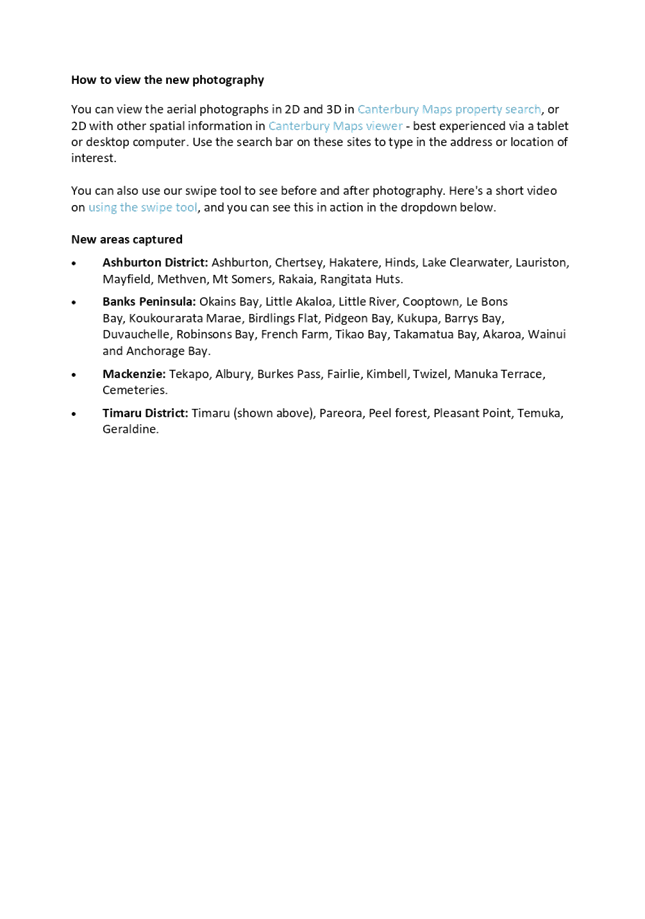
13. New aerial photography of our region
New
aerial photography of the Ashburton, Banks Peninsula, Mackenzie and Timaru
districts has been captured by Canterbury local authorities and Environment
Canterbury.
Attachment
5 includes the media release information about the new photography
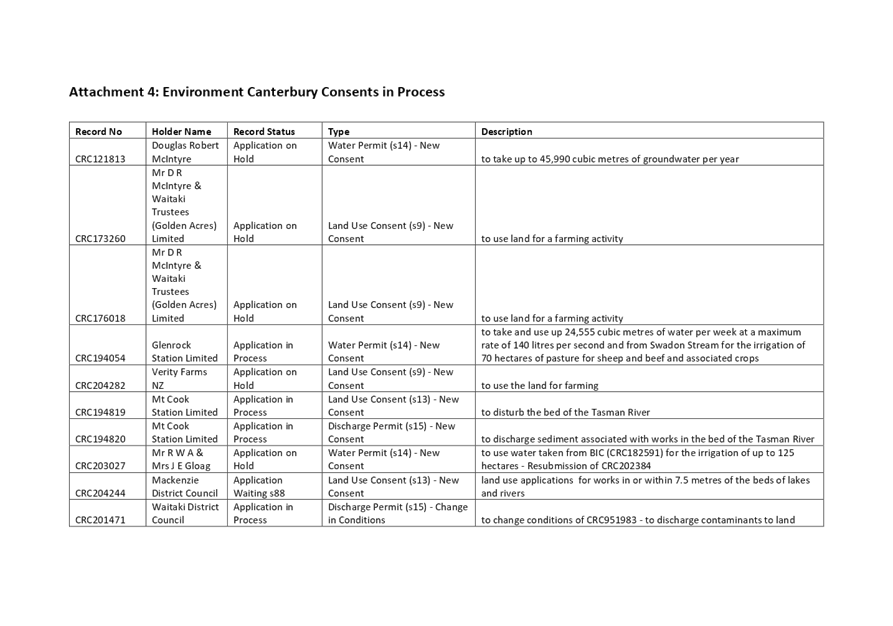
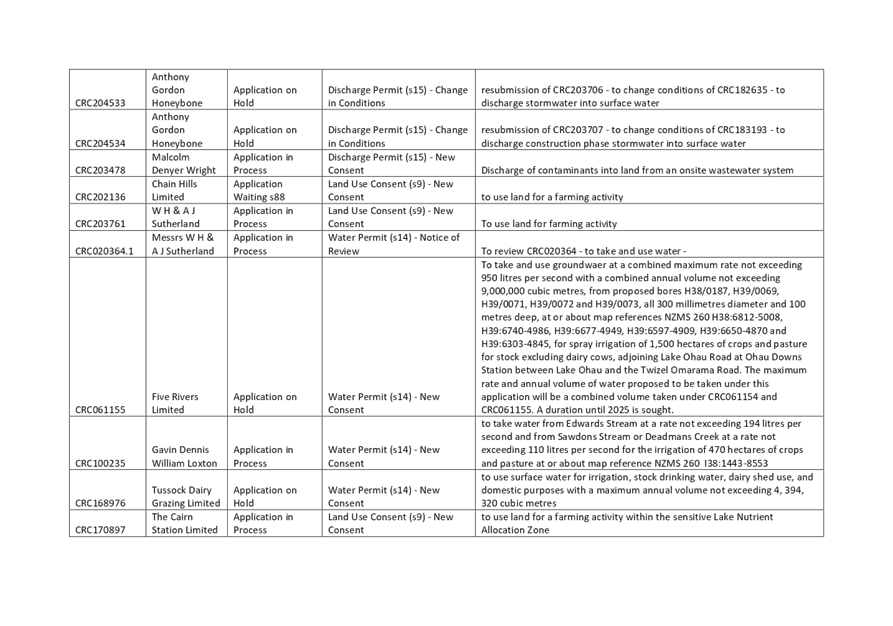
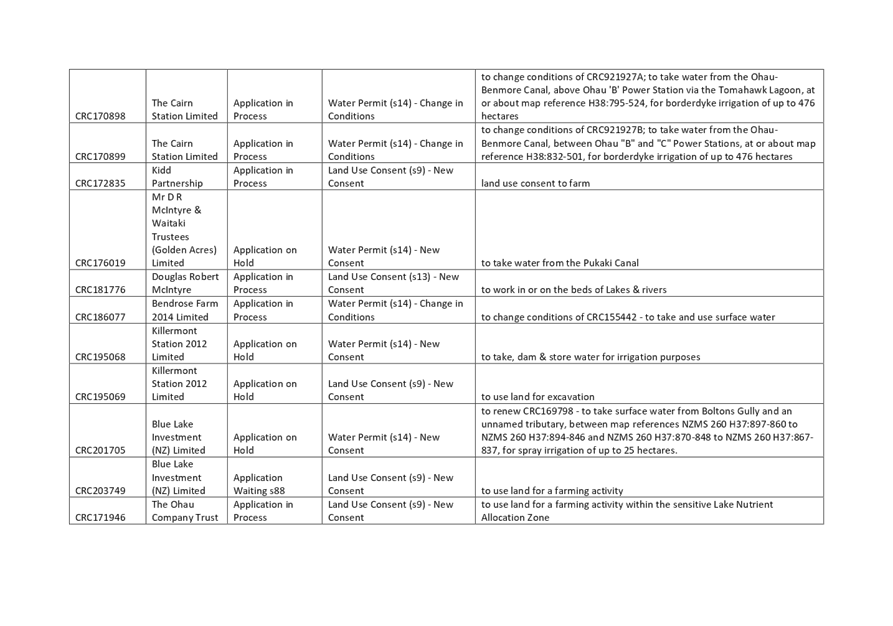
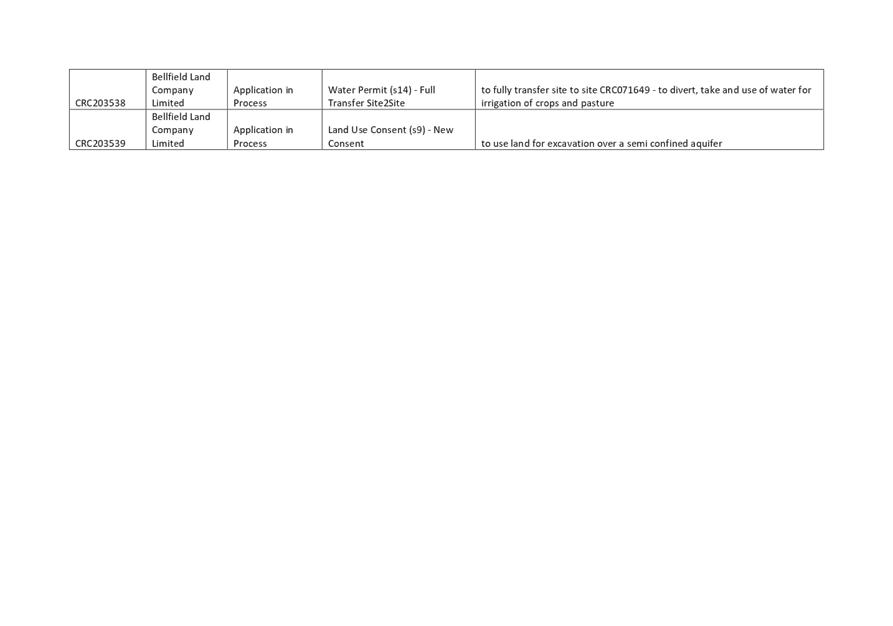
14. Environment Canterbury Consents in Process
Attached (Attachment
6) to this paper is a list of resource consents in process with Environment
Canterbury. This has been included for the Committee’s and community
reference only. This information is also publicly available on Environment
Canterbury’s website.
Upper Waitaki Zone Water Management Committee Meeting Agenda 19
June 2020
Upper Waitaki Zone
Water Management Committee Meeting Agenda 19
June 2020

Upper Waitaki Zone
Water Management Committee Meeting Agenda 19
June 2020

Upper Waitaki Zone
Water Management Committee Meeting Agenda 19
June 2020
Upper Waitaki Zone Water Management Committee Meeting Agenda 19
June 2020
Upper Waitaki Zone
Water Management Committee Meeting Agenda 19
June 2020
Not
all the recommendations made in the report have been implemented because they
are no longer relevant (e.g. recommendations relating to land tenure review and
Joint Management Agreements). Other recommendations have since been implemented
by wider initiatives supported (but not directed by the Alignment Programme)
including those relating to a predator-free and drylands areas.